


A typical week
There’s no such thing as a standard schedule in Prague, because every teacher’s timetable is different, but here’s what the pattern tends to look like once you’re established.
Early mornings (7:30 to 9:00) are dominated by in-company classes. You travel to an office somewhere in the city and teach a group of professionals before their workday starts. These are usually booked through a language school that acts as the intermediary: you invoice the school, the school invoices the company.
Mid-morning is often a gap. Depending on where your next class is, you might use this time for preparation, admin, a private student, or simply getting across town.
Lunchtimes (12:00 to 14:00) bring another wave of company classes, with professionals using their lunch break for English.
Afternoons are quieter for some teachers, busier for others. Language schools fill the 16:00 to 19:30 slot with children’s groups, teen exam preparation, and adult evening classes. If you’re teaching young learners, this is your peak time.
Evenings wind down between 20:00 and 21:00, depending on how many classes you’ve stacked. Some teachers prefer to front-load their week (heavy Monday to Thursday, light Friday), while others spread it evenly.
The result is a schedule with built-in gaps. How you use those gaps – productively or resentfully – is one of the biggest factors in whether you enjoy teaching in Prague.
The transport question
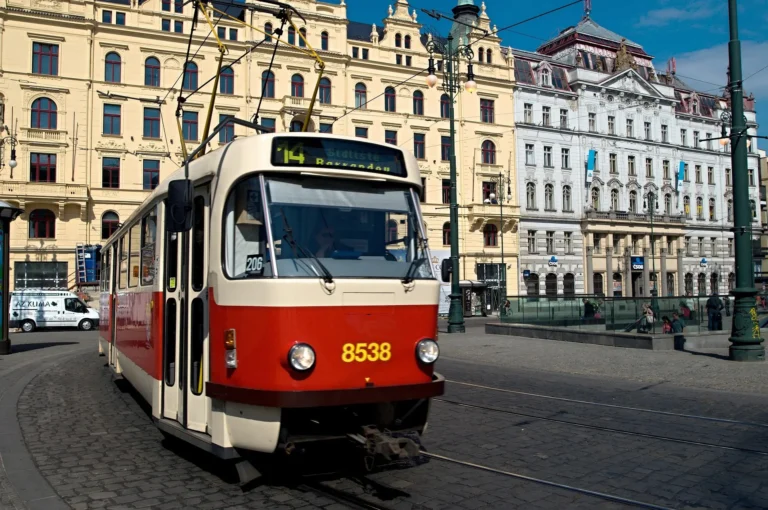
Prague’s public transport is excellent: frequent, reliable, and covering the whole city. The metro has three lines (A green, B yellow, C red), supplemented by an extensive tram and bus network. A monthly pass costs 550 CZK and is non-negotiable: you’ll use it constantly.
The practical skill to develop in Prague is clustering: arranging your classes so that everything on a given day falls along a single metro or tram line. This minimises the unpaid travel time between lessons that can eat into your effective hourly rate. A 400 CZK per 45-minute lesson sounds good, but not if you spend 45 minutes getting to and from it with no pay for the transit.
When schools offer you new classes, check the location before you accept. A lesson on the other side of the city at an awkward time might not be worth taking if it creates an hour of dead time between two other lessons. Experienced teachers learn to say things like “I’d be happy to take classes in Vinohrady and Žižkov, but I can’t make Černý Most work on Tuesdays”, and schools generally respect this.
The 45-minute lesson
In the Czech Republic, a “lesson” (vyučovací hodina) is traditionally 45 minutes, not 60. Many language schools and in-company clients quote and pay in 45-minute units.
This means a timetable showing “25 lessons per week” is actually about 19 clock hours of teaching, plus travel, preparation, and admin. When calculating your effective income, always convert to clock hours to understand what you’re actually earning per hour of your time.
Some schools pay per 60-minute hour, others per 45-minute unit, so always clarify which you’re being quoted before accepting work.
Finding work
The job search in Prague is hands-on and fast-moving. Here’s the most effective approach:
Shortlist a dozen schools in your target area of the city. Use the Eslbase school directory, Expats.cz, Jobs.cz, and school websites directly.
Send a concise CV with a small headshot (common in Prague, though not mandatory), your TEFL certificate, and a short note about your availability and location.
Follow up by phone or email to request an in-person meeting. Schools often move quickly, and you may be asked for a demo lesson the same day or the next.
Have your demo ready. A prepared 10 to 15 minute activity is essential. Schools want to see clear staging, natural rapport, and the ability to respond to what the learner actually says. Having two or three adaptable demos (one for adults, one for teens, one for young learners) means you can respond confidently whatever they ask for.
Group your interviews by area. Schedule all your Vinohrady meetings on one day, all your Anděl meetings on another. This saves hours of criss-crossing the city.
After each interview, send a brief thank you email with your current timetable gaps visible. This makes it easy for a Director of Studies to slot you into a new group immediately.
Housing
Prague’s rental market uses a room-code system. The first number is habitable rooms; the suffix tells you about the kitchen: “+kk” is a kitchenette, “+1” is a separate kitchen. So “1+kk” is a studio with kitchenette, “2+1” is two rooms plus a separate kitchen.
Most new teachers start in flat-shares, and Facebook housing groups, Sreality.cz, and Expats.cz are the main channels. A room in a shared flat typically costs 8,000 to 12,000 CZK per month. Many teachers move to a solo apartment once their income stabilises.
Deposits of one to three months’ rent are standard. Monthly rent often includes an estimated utilities line that’s reconciled at year-end against meter readings. Ask your landlord to show last year’s settlement (vyúčtování) so you know whether the estimate is realistic.
Where to live: popular teacher neighbourhoods include Vinohrady (central, well-connected, slightly higher rent), Žižkov (grittier, cheaper, good transport), Smíchov/Anděl (B line, good access to business districts), and Letná/Holešovice (north of the river, increasingly popular). Choose based on where your main teaching locations are: a shorter commute improves your quality of life more than a nicer flat in the wrong part of town.
What makes or breaks the experience
You can thrive in Prague if you’re organised (the patchwork schedule rewards planning), you’re flexible (accepting that early mornings and evening work are the norm), you’re proactive (approaching schools directly rather than waiting for ads), and you treat the self-employed admin as part of the job rather than an annoyance.
Teachers who struggle are usually those who expected a single employer, a fixed salary, and a 9-to-5 schedule. Prague doesn’t offer that at the language school level. What it does offer is the freedom to build your own timetable, work with multiple clients, and live in one of Europe’s most beautiful cities, and for the right person that’s worth a great deal.