

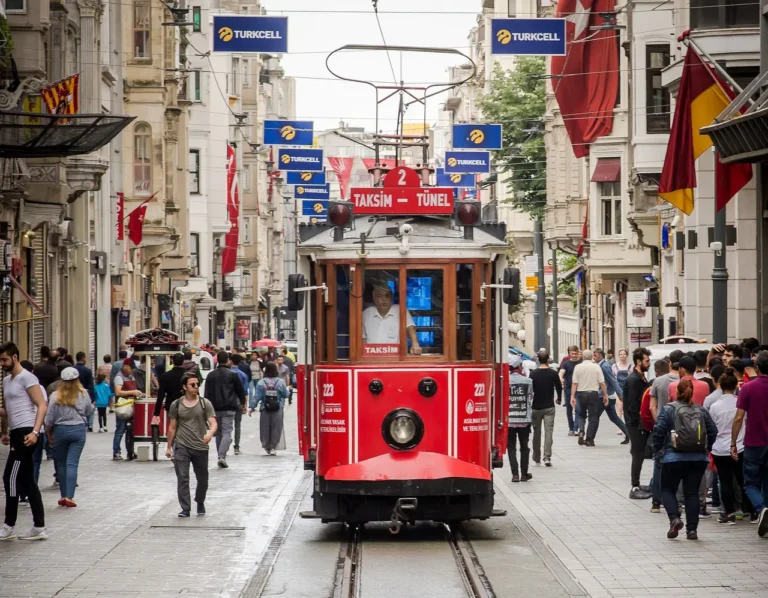

The geography problem
Istanbul straddles Europe and Asia, and as a teacher you’ll feel that every day. The European side (west of the Bosphorus) is where the majority of language schools, corporate offices and international institutions are concentrated. The Asian side (east) is generally more residential, calmer and cheaper, with fewer but still significant teaching opportunities.
Crossing between the two sides during rush hour can take 45 minutes to over an hour, even by metro or Marmaray tunnel. Accept a job on the opposite side from where you live and you’ll quickly discover that your effective hourly rate drops dramatically once transit time is factored in.
The commute costs money as well as time. A monthly public transport pass costs around ₺2,750, and if you’re teaching across multiple sites you’ll be paying that plus taxis when the metro won’t get you there in time between classes.
Before you accept any job, check exactly where your classes will be held and test the commute at the time you’d actually be travelling. A school in Kadikoy sounds fine if you live in Uskudar, but not if you live in Beylikduzu. An early morning company class in Maslak works if you’re in Sisli, not if you’re south of the Golden Horn.
If you want to thrive in Istanbul, live close to your main teaching locations. Otherwise you’ll spend hours a week in transit that could have gone on teaching, earning or resting.
European side vs Asian side
The European side has the larger concentration of employers. Beyoglu, Sisli, Levent and Maslak have strong corporate markets, and in-company Business English makes up a large part of the work there. Bakirkoy, Bahcesehir and Beylikduzu have growing residential populations with language centres and K-12 schools. Fatih and Sultanahmet are more touristy and less relevant for teaching unless you’re doing private tutoring with hotel and tourism workers.
For a teacher, the European side means more job options but higher rents and more intense urban life. If you’re working across multiple schools (which most language centre teachers do), being on the European side generally gives you shorter distances between clients.
The Asian side (Kadikoy, Uskudar, Atasehir, Maltepe) is where many teachers choose to live, even if they work on the European side. Rents are lower, the neighbourhoods are more residential and the daily pace is calmer. Kadikoy in particular has become a popular teacher neighbourhood, with good transport links (ferry, Marmaray, metro), a lively food and cafe scene and rents that, while rising fast, still undercut central European-side districts. It’s where our course in Istanbul is based.
The trade-off is the commute. If your school is in Levent and you live in Kadikoy, you’re adding 30 to 45 minutes each way to your day. Some teachers find this acceptable; others find it draining over a full year.
A typical teaching week
Istanbul’s teaching rhythms follow the same broad pattern as the rest of Turkey, but the city’s scale amplifies everything.
Language centre teachers typically work late afternoons and evenings (4pm to 9pm), with some weekend morning sessions. Children and teens fill the after-school slots; adults take evening classes. Some schools also arrange corporate on-site classes during early mornings (7:30 to 9:00) and lunchtimes, which means your day can have a long gap in the middle. Full-time usually means 20 to 25 contact hours per week, but you’ll be on site for meetings and planning beyond that.
K-12 school teachers follow a standard school day (roughly 8am to 4pm), Monday to Friday. The schedule is more predictable, with regular classes, assemblies, parent meetings and exam periods, plus coordinator support and structured resources. Many teachers find this steadier rhythm suits them better than the language centre model, particularly in a city where commuting already takes energy.
Private tutoring fills the gaps for many teachers. Istanbul has a large and enthusiastic market for one-to-one English. IELTS preparation, Business English, Cambridge exams and children’s tutoring are all in demand. Most teachers find private students through word of mouth, WhatsApp groups and local Facebook communities. But check your contract, because some schools include exclusivity clauses that restrict private work, and check your work permit terms, since your permit covers a specific employer.
Housing
This is where Istanbul has changed most in recent years. Rents have risen faster than salaries, and affordable living in a city of this size, once one of Istanbul’s biggest selling points, is no longer something you can take for granted.
A one-bedroom flat outside the city centre typically costs ₺25,000 to 35,000 per month. Central and sought-after districts (Beyoglu, Cihangir, Karakoy and increasingly central Kadikoy) cost ₺40,000 to 60,000, with newer or premium buildings well beyond that. Numbeo’s Istanbul averages in mid-2026 sat at around ₺29,700 outside the centre and ₺46,100 in the centre, with a wide spread either side depending on district and building. The Asian side is still generally cheaper, but the gap has narrowed.
Set that against a teaching salary and the conclusion is unavoidable. Most teachers share. A flat-share with another teacher or a local flatmate is the standard arrangement in Istanbul now, not a temporary economy measure while you find your feet. Teacher WhatsApp groups, Facebook housing groups, Sahibinden listings and word of mouth through your school or TEFL course are the main ways to find a room.
Budget beyond the rent itself. Deposits are typically one month, sometimes two. Most apartment buildings charge a monthly maintenance fee (aidat) on top of rent, which is easy to overlook when comparing listings and can add meaningfully to your monthly outgoings. Utilities for a small flat, unfurnished flats being common, and basic furnishing all need factoring in before your first salary arrives. Landlords may also ask for proof of employment or a Turkish guarantor, and your school can sometimes help with this.
What makes Istanbul worth it
After all the warnings about commutes and rent, Istanbul is a rewarding place to live. Ottoman history sits alongside contemporary art, neighbourhood street food, Bosphorus ferries, rooftop terraces and the call to prayer at dawn. Turkish colleagues will invite you for tea, neighbours will bring food and students will thank you in ways that feel personal rather than perfunctory.
The teaching is engaging. Turkish students, children and adults alike, tend to be warm, expressive and relationship-oriented. Building rapport with a class here is one of the great pleasures of the job. The professional variety matters too. In one week you might teach young learners at a language centre, deliver a Business English presentation skills class at a corporate office and tutor a university student for IELTS, each requiring different skills and keeping the work interesting.
Istanbul’s scale is both its challenge and its reward. If you learn to work with the city’s rhythms, clustering your schedule, choosing your district carefully, building your network, you’ll find a quality of life that’s hard to match elsewhere at this price point. Fight the city’s size instead of adapting to it, and you’ll burn out.
The practical checklist
Before you accept a job in Istanbul, confirm these:
– Where exactly are your classes held? Not just the school’s main address, but the actual teaching locations, including any off-site company classes.
– What does the commute look like at the time you’d be travelling? Test it on Google Maps at the relevant time of day, not at midday.
– Does the school handle your work permit properly? Ask for a timeline, ask whether it has sponsored foreign teachers before and ask to speak with a current one.
– What’s your gross salary in lira, and what are the contract terms? Get contact hours, on-site hours, pay dates, SGK, holidays and overtime in writing.
– Where will you live relative to your main teaching sites, and what will that district actually cost including aidat and bills? This decision affects your daily life more than any other.